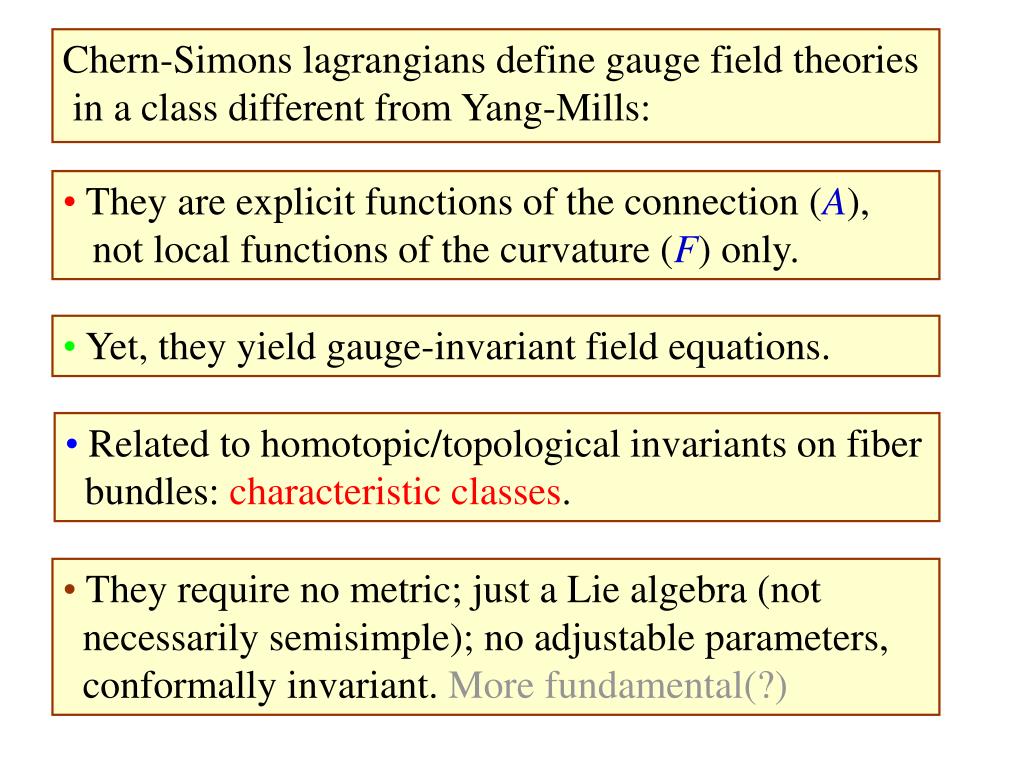
In mathematics, the Chern–Simons forms are certain secondary characteristic classes. The theory is named for Shiing-Shen Chern and James Harris Simons, co-authors of a 1974 paper entitled "Characteristic Forms and Geometric Invariants," from which the theory arose.

Definition

Given a manifold and a Lie algebra valued 1-form A {\displaystyle \mathbf {A} } over it, we can define a family of p-forms:

In one dimension, the Chern–Simons 1-form is given by

Tr [ A ] . {\displaystyle \operatorname {Tr} [\mathbf {A} ].}

In three dimensions, the Chern–Simons 3-form is given by

Tr [ F A 1 3 A A A ] = Tr [ d A A 2 3 A A A ] . {\displaystyle \operatorname {Tr} \left[\mathbf {F} \wedge \mathbf {A} -{\frac {1}{3}}\mathbf {A} \wedge \mathbf {A} \wedge \mathbf {A} \right]=\operatorname {Tr} \left[d\mathbf {A} \wedge \mathbf {A} {\frac {2}{3}}\mathbf {A} \wedge \mathbf {A} \wedge \mathbf {A} \right].}

In five dimensions, the Chern–Simons 5-form is given by

Tr [ F F A 1 2 F A A A 1 10 A A A A A ] = Tr [ d A d A A 3 2 d A A A A 3 5 A A A A A ] {\displaystyle {\begin{aligned}&\operatorname {Tr} \left[\mathbf {F} \wedge \mathbf {F} \wedge \mathbf {A} -{\frac {1}{2}}\mathbf {F} \wedge \mathbf {A} \wedge \mathbf {A} \wedge \mathbf {A} {\frac {1}{10}}\mathbf {A} \wedge \mathbf {A} \wedge \mathbf {A} \wedge \mathbf {A} \wedge \mathbf {A} \right]\\[6pt]={}&\operatorname {Tr} \left[d\mathbf {A} \wedge d\mathbf {A} \wedge \mathbf {A} {\frac {3}{2}}d\mathbf {A} \wedge \mathbf {A} \wedge \mathbf {A} \wedge \mathbf {A} {\frac {3}{5}}\mathbf {A} \wedge \mathbf {A} \wedge \mathbf {A} \wedge \mathbf {A} \wedge \mathbf {A} \right]\end{aligned}}}

where the curvature F is defined as

F = d A A A . {\displaystyle \mathbf {F} =d\mathbf {A} \mathbf {A} \wedge \mathbf {A} .}

The general Chern–Simons form ω 2 k 1 {\displaystyle \omega _{2k-1}} is defined in such a way that

d ω 2 k 1 = Tr ( F k ) , {\displaystyle d\omega _{2k-1}=\operatorname {Tr} (F^{k}),}

where the wedge product is used to define Fk. The right-hand side of this equation is proportional to the k-th Chern character of the connection A {\displaystyle \mathbf {A} } .

In general, the Chern–Simons p-form is defined for any odd p.

Application to physics

In 1978, Albert Schwarz formulated Chern–Simons theory, early topological quantum field theory, using Chern-Simons forms.

In the gauge theory, the integral of Chern-Simons form is a global geometric invariant, and is typically gauge invariant modulo addition of an integer.

See also

  • Chern–Weil homomorphism
  • Chiral anomaly
  • Topological quantum field theory
  • Jones polynomial

References

Further reading

  • Chern, S.-S.; Simons, J. (1974). "Characteristic forms and geometric invariants". Annals of Mathematics. Second Series. 99 (1): 48–69. doi:10.2307/1971013. JSTOR 1971013.
  • Bertlmann, Reinhold A. (2001). "Chern–Simons form, homotopy operator and anomaly". Anomalies in Quantum Field Theory (Revised ed.). Clarendon Press. pp. 321–341. ISBN 0-19-850762-3.

ChernSimons Forms. An Introduction to a Topological Theory by Afiq

PPT Uses of ChernSimons Actions PowerPoint Presentation, free

Chern Simon PDF Gauge Theory Quantum Field Theory

ChernSimons current in KRAS gene. Figure 2a shows the comparison

ChernSimons theory and the Rmatrix